

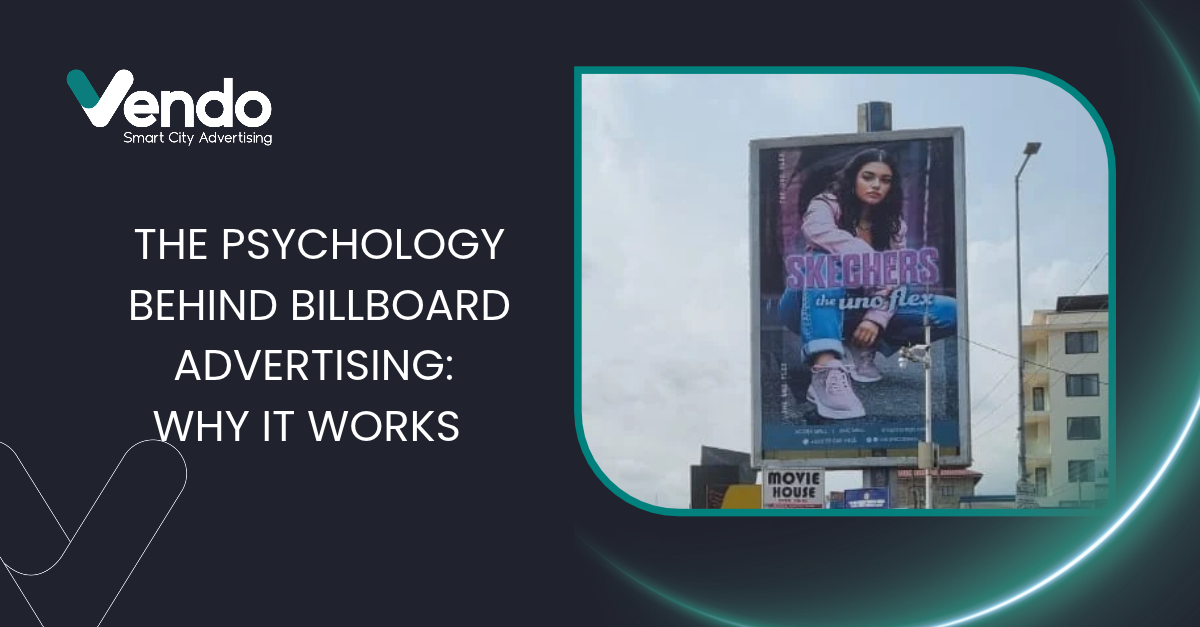
The Psychology Behind Billboard Advertising: Why It Works
Every day, people move through the same roads on their way to work, school, shopping centers, restaurants and home. Along the way, they encounter hundreds of visual messages competing for their attention.
Yet some brands stay with us.
You may not remember every billboard you passed this morning, but a brand you see repeatedly on your daily route can gradually become familiar. That is one of the reasons billboard advertising remains a powerful tool for building brand awareness.
The psychology behind Out-of-Home (OOH) advertising goes beyond making an immediate sale.
It is about attention, familiarity, repetition, memory and being present when consumers are ready to make a decision.
Today we discuss five psychological principles that help explain why billboard advertising works.
1. The Mere Exposure Effect: Familiarity Matters
One of the most well-known concepts in psychology is the mere exposure effect, which concerns how one can be influenced to develop positive feelings towards something one is often exposed to.
In advertising, this matters because consumers are constantly making choices between brands.
A person may see a particular brand on their commute Monday morning, again on Wednesday, and several more times throughout the month. Each exposure may seem insignificant, but collectively, those encounters can contribute to familiarity with the brand.
This doesn’t mean that simply seeing an advertisement guarantees a purchase. Rather, repeated exposure can help make a brand more recognizable and easier to retrieve from memory.
For billboard advertising, this is particularly relevant because OOH placements can remain in the same physical location for extended periods.
The idea is simple: the more familiar a brand becomes, the less unfamiliar it feels.
2. Repetition Strengthens Brand Recall
Advertising rarely works because of one isolated impression.
Consumers encounter brands repeatedly across different channels and at different points in their daily lives. Repetition gives a brand more opportunities to register in memory.
A billboard doesn’t have to convince someone to buy something the moment they see it. It can simply make sure the brand is there, again and again.
Then, when the consumer eventually needs the product or service, the brand may already be familiar.
3. Location Creates Context
A billboard isn’t displayed in a random environment.
Its location can influence who sees it, how often they see it and what they are doing when they see it.
A billboard near a shopping district can reach consumers while they are already in a purchasing environment.
A billboard along a major commuter route can repeatedly reach people travelling to and from work.
An advantage called proximity. The right location therefore isn’t simply about traffic. A billboard near a restaurant, retail outlet or service center can provide visibility close to the point where a consumer might take action. It is about putting the right message where the right audience is likely to encounter it.
4. Our Brains Have Only a Few Seconds
Unlike a social media post, a website, or a television commercial, a billboard often has to communicate its message while people are moving.
Drivers and passengers may only have a few seconds to process what is in front of them. That makes simplicity extremely important.
Effective billboard creative often relies on:
- A short, powerful headline
- One clear idea
- Strong visual hierarchy
- Easy-to-read typography
- Distinctive branding
- A clear call to action where appropriate
The goal isn’t to tell the consumer everything. The goal is to make the message understood quickly. A billboard overloaded with text may technically contain more information, but that doesn’t necessarily mean it communicates more effectively. In OOH, clarity is a competitive advantage.
5. Consistent Visibility Can Strengthen Brand Presence
There is another psychological factor worth considering, which is consistency.
A brand that maintains a visible presence over time can appear more established and easier to recognize than one that appears only occasionally.
This doesn’t mean consumers automatically trust a brand simply because they see their billboard.
